

Market research · 23 July 2026 · 13 min
Real estate resilience after conflict: what the data can—and cannot—promise
A sober study of how Dubai and other global hotspots absorb shocks, why activity can return quickly, and why resilience must never be presented as a guaranteed rebound.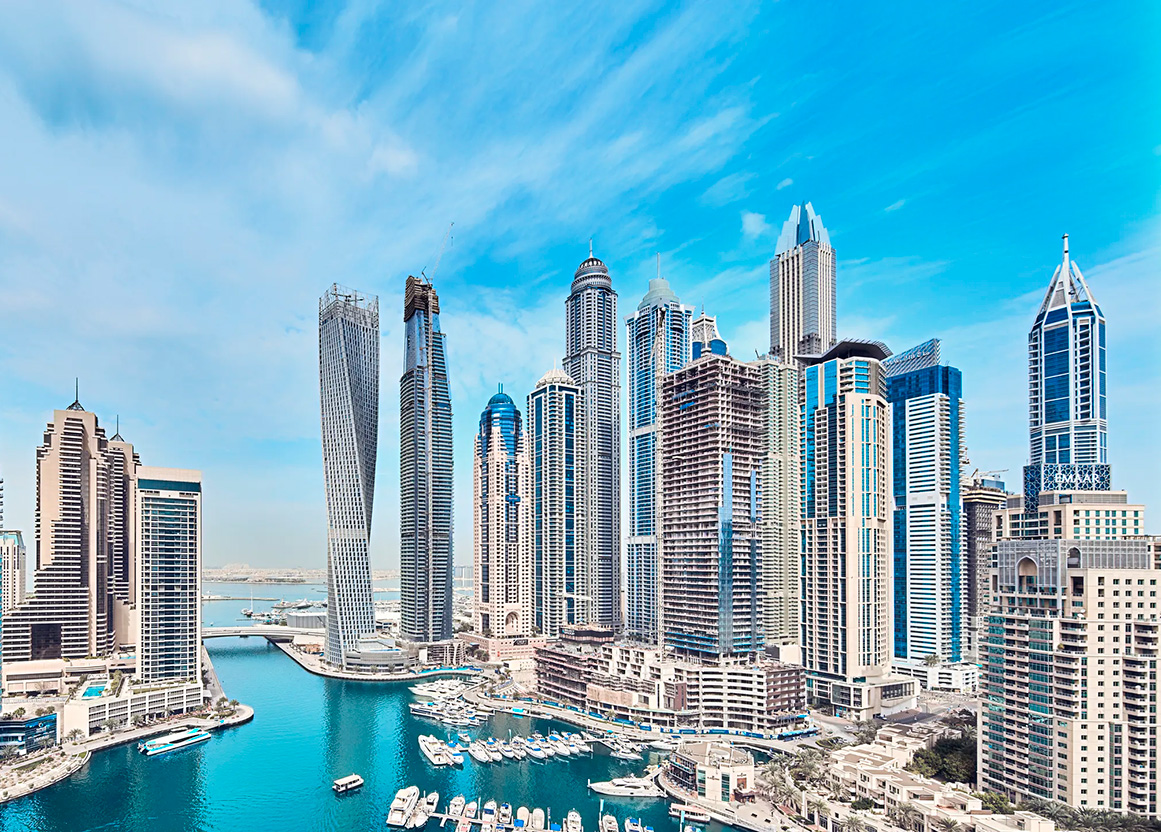
Evidence dashboard
Read the signal.
Keep the definition.
Monthly pulse
Activity slowed sharply in March, without erasing Q1 growth
The first two months averaged 16,100 residential sales. March recorded 12,900 as the regional conflict interrupted momentum; the quarter still finished 4% above Q1 2025 by volume.
Global hotspot comparison
Five-year prime residential price performance is highly uneven
The comparison provides context, not a forecast. Each city has different taxes, financing conditions, supply constraints and currency exposure.
Resilience is a process, not a slogan
Real-estate markets do not always bounce back better, and the timing of any recovery cannot be guaranteed. A resilient market is one that can continue registering transactions, funding projects, operating buildings and attracting residents while repricing risk transparently.
The first response to conflict is usually a widening gap between buyers and sellers. Volumes can fall before headline prices move because owners delay listing and buyers pause. Construction logistics, insurance, aviation and corporate mobility can then transmit the shock differently across off-plan, ready, prime and income-producing assets.
The Q1 2026 record shows both interruption and continuity
Emirates NBD Research recorded a fall from an average 16,100 monthly residential sales in January and February to 12,900 in March as conflict disrupted momentum. Yet Q1 volume remained 4% above the same quarter in 2025. CBRE likewise described a transition toward recalibration while recording more than 45,000 sales and over AED 137 billion in value.
This is not proof that the market is immune. It shows that the shock arrived after two strong months and that registrations, product mix and price measures moved at different speeds. April and subsequent quarters are required to distinguish a pause from a deeper cycle change.
Why global hubs can absorb shocks differently
International gateways draw demand from employment, education, lifestyle, wealth migration and currency diversification. Their buyer pools can be broader than those of markets dependent on one domestic credit cycle. At the same time, global hubs are exposed to cross-border capital rules, travel disruption and shifts in risk appetite.
Knight Frank’s five-year prime residential comparison placed Tokyo, Dubai, Seoul, Miami and Manila among the strongest performers to Q2 2025, while London and New York were slightly negative. The dispersion demonstrates that prestige alone does not determine performance; supply, taxation, financing and policy matter.
Dubai’s earlier recovery provides a useful—but limited—analogy
During the 2020 pandemic shock, Dubai Land Department recorded 1,452 sales in May, 2,404 in July, 3,849 in September and 3,751 in December. The market recovered activity rapidly as restrictions eased, and 2021 subsequently registered more than 84,000 real-estate transactions worth almost AED 300 billion.
A pandemic is not a war, and one recovery path should not be copied onto another shock. The useful lesson is operational: policy response, safe mobility, banking liquidity, construction continuity and transparent registration can shorten the period between uncertainty and price discovery.
How an investor should navigate a conflict window
Preserve liquidity, reduce reliance on a near-term resale, verify construction and escrow status, and stress-test rent and completion timing. Prefer assets with a deep comparable set, usable layouts and an identifiable end-user base. A discount is meaningful only when the underlying cash flow and legal position remain sound.
Watch monthly transfers, mortgage registrations, cancellations, handovers, tenancy renewals, hotel and aviation demand, and corporate occupancy. A genuine recovery is broader than a launch-week sales spike: it appears across repeat transactions, leasing, absorption and operating performance.
The correct conclusion
Dubai has repeatedly demonstrated an ability to adapt, supported by infrastructure, international connectivity, government capacity and a more mature property-data and regulatory system. Those strengths improve recovery capacity.
They do not eliminate cycle risk. The responsible investment case is not that real estate always rebounds higher after conflict; it is that well-capitalised global hubs can navigate shocks more effectively when liquidity, governance, demand diversity and asset quality remain intact.
Research sources
Emirates NBD Research: Dubai Residential Review Q1 2026CBRE: UAE Real Estate Market Review Q1 2026Dubai Land Department: 2020 official sales-price indexDubai Land Department: 2021 market resultsKnight Frank: The Residence Report 2025–26This content is general market information, not a promise of returns or personal financial advice. Verify live inventory, contracts, fees and eligibility before committing capital.